English French German Spain Italian Dutch Russian Portuguese Japanese Korean Arabic Chinese Simplified

this widget by www.AllBlogTools.com
Showing posts with label Studio. Show all posts

Home Recording Equipment: Signal Flow


Signal flow is an important part of any home music studio. A creative thought goes from your mind to electrical signal through various components of your home music studio. how they work together and relate to one another is important. If you wrap your head around signal flow, all the inputs and outputs and how they relate to one another you will be in more creative control of your home music studio. When it comes to troubleshooting this also applies because you can improve how your studio works, adding new equipment and making it easier to transfer your ideas into recordings faster.

Using a simple set up with a computer, audio interface, speakers and microphone I can show you how to understand a home music studio signal flow. the truth is it is about inputs an outputs, that simple. Knowing how inputs and outputs work together in your recording chain will give you the freedom to add and multiply equipment in your home music studio and keep you in control of the creative process

Having a creative idea is just the start, that creative idea leaves as an analogue sound wave, lets say from a guitar and IN a microphone. That signal then comes OUT the end of the microphone cable and IN an audio interface or microphone preamp. At this early stage you will connect your microphone cable to the input of the audio interface. Now that the signal has made its way into the audio interface the signal needs to leave OUT of your speakers so you connect your speakers to the output of the audio interface. Most home recording equipment have multiple inputs and outputs so that you can put equipment in different places in the signal flow .

The first thing an audio interface does is convert analogue sound waves into a digital format so computers can understand. The second function of an audio interface is to again flip the digital audio into analogue so that speakers can playback audio from your computer. The reason why I say to go the audio interface route is because of the sample rates they use to convert analogue to digital and digital to analogue. This sample rate makes a big difference for quality recordings.

The two outputs of an audio interface makes it possible to playback audio from your recording software as well as being able to connect the output of the audio interface to the USB or firewire input of your computer

I realize this is a very simplistic example but if you learn to move around your studio thinking about the IN and OUT concept you can add to your home music studio, set up and experiment connecting the inputs and outputs of all types of gear together and putting you in control.

Looking to buy the best Home Recording Equipment? Get the low down now with our comprehensive Home Music Studio overview.
Article Directory : http://ArticleDirectory.com

Easy Steps To Soundproofing Walls In Your Recording Studio

 By Justin Hayes

The benefits of soundproofing walls in your home are many. No matter what your reason, you will certainly appreciate the short time and effort required to accomplish this task. On the other hand, if you are trying to set up a home recording studio, it is an absolute necessity.

The truth is, newer homes are far from soundproofed. So, anyone can overhear others talking, even when they are trying to be discreet. So, it can lead to a slew of other problems. In homes where a growing family lives in, privacy can really be an issue. Parents need some time away where they can talk and spend time together. It's nice for them to know that they don't have to whisper and tiptoe around continuously when their children are asleep, for fear of making them.

Or, the sounds of those walking on upper levels can drive others on the lower levels absolutely mad. Couple that with the fact that many people have taken on home offices and working directly from the house. While it is good on one hand, it can be quite frustrating to concentrate with all the noise that goes on around you. But, you can resolve these issues in a quick and easy manner.

For those who are serious about their home recording studio, optimum sound can only be had in an environment that is soundproofed. There are no ifs ands or buts about it. The fact is, without the room being soundproofed, the playback of music will be poor and lacking in many ways. Additionally, there could be different types of interferences and feedback that will affect your music.


Of course, there are different ways to go about this, but it doesn't have to be extremely expensive. In fact, you can do it economically. In fact, it doesn't even require any serious work or demolition nor many supplies. The answer to this is applying Green Glue on your drywall and then adding another layer of drywall to each side of the wall.

Soundproofing Wall Instalation
Of course, it has to be done on both sides of the wall you were soundproofing. The layer of glue will be easily applied on the wall, the drywall will be adhered to it, and screwed in with proper screws. Then, plaster, drywall tape and such will have to be applied to finish the job and make it look right. It is an effective method because of the glue which is a viscoelastic dampening compound that prohibits sound or noise from penetrating the surface.

As you probably already know, voices and sounds travel. But, This Green Glue avoids this from occurring. Furthermore, it doesn't allow the sound to flank and penetrate the ceiling either. In other words, you won't have to work on floors and ceilings to get the best sound proofing results. The only thing you have to focus on are the actual walls.

The job in question will only require about a day, depending on the size of the room. And, if you have help, you can cut that time even further. Once the soundproofing is completed and the walls are nicely finished, they can be painted, wallpapered or finished in any decor method of your choice. 

To get more information about Soundproofing Walls make sure you look at more of these free tips at Recording Studio Design
Article Directory : http://ArticleDirectory.com

Getting Ready for Recording Studio Sessions

By Drake Crossland

Stepping into a state-of-the-art recording studio to record with a band is a dream come true for many musicians. But time spent in a recording studio is very expensive and if you show up unprepared you can end up having a costly and difficult experience. Here are a few things to keep in mind to prepare your band for their first trip to the studio.

Prepare Well

To make the most of your money, you don’t want to waste any time in the recording studio. Make sure you know the songs you plan to record inside out. Working out vaguely defined sections of a song or practicing a difficult riff while on the clock will break the bank for most beginner musicians. Have structured practice sessions before the day you plan to record.

Most recording studios start charging at a set time regardless of if you are there or not. Make sure you have everything packed up and ready to go before you are scheduled to arrive. Make sure your instruments are properly tuned and that you have replacement strings, drum sticks, and picks.

What to Expect 
 
The initial setup for recording comes as a surprise to many musicians. You may spend up to four hours of time simply setting up the instruments and playing while the engineer gets the levels right. This can be especially tiresome for getting the right drum sound. Come prepared with samples of guitar and drum sounds that you like so that the engineer can attempt to dial in a similar sound for your recording session.


First, your band will lay down the basic tracks of the song. This usually includes drums, bass and rhythm guitars. Most studios have the ability to record multiple instruments at once. Alternatively, they will let you play along while one instrument is recorded to help keep the place in the song. The entire process goes much smoother if the drummer – who keeps the beat and structure of the song intact – knows every detail of every song.

After the basic rhythm tracks have been recorded, you get to the more exciting part of adding vocals, solos, percussion, samples or other flourishes that fill out the sound of the band. Don’t be surprised if everything takes a lot longer than you expected. Keep things moving by having band members who are not recording practice in another room for the part they will soon perform. This way, everyone is contributing to getting through the process as efficiently and cheaply as possible.

Mistakes to Avoid

The recording studio is not a place to party. Drinking, smoking, and other drugs will only make it harder to perform at your best. Having guests come to the recording studio may serve as a distraction that wastes time and money.

It is also important to know when to call it a day. If you are recording vocals and your voice is shot, it will show. Recording can be an mentally and physically exhausting. If you are too tired to perform your parts well, switch to having another part recorded for the rest of that session.

Success in the recording studio can make or break a band’s career. Make sure to prepare well for your recording session and get your music out there for the world to hear. 

For more information and for professional advice regarding your music career, please visit recording studios in Toronto.

Article Directory : http://ArticleDirectory.com

How To Make Music At Your Home With Music Software


In the past, creating music was a costly thing, but with cheap beat software that is no longer the case. Now, one need not invest in a full compliment of instruments and lessons to express themselves or their vision through music.

Instead, musicians are catapulting their careers with just a laptop and a natural feel for rhythm and sound. If you, like numerous artists who are getting their start, have a lot of ideas but little money to invest, think about utilizing a beat program to make a inexpensive home recording studio.

One of the best benefits of a beat program is that you don't require the ability to read music. Instead, users can effortlessly work with a large variety of prerecorded instrumentals and percussive sounds with one click of a mouse. This makes it easier to compose by ear, as you can listen to changes as you make them. Saving is easy, and many musicians work on a number of beats at once, returning to them at their leisure.

While sampling has turned into a well liked means of getting beats, using copyrighted material can set you up for failure. If you hope to market and profit from your music in the future, and most people do, sampling can be a huge legal obstacle, and one that can prevent you from getting a contract from a label.

Beat software enables any person to make their own custom beats. As these beats represent your original work, you own all the rights. This means that you are free to market the songs in any way you would like, without opening yourself up to legal challenges in the future.

Beat programs have grown into cheap and easy to use, that it is now being used by serious musicians and hobbyists alike. The best software is designed to be easy to learn, and can be used to create music in almost any beat driven genre.

Click Here to check out the best Music Creator Software and discover how you can make a lot of best quality beats using a method to get you in the zone. Once get in the zone you will be on best of your game.
Article Source: http://ArticleDirectory.com

Tips on Buying Music Gear for Home Studios

by Victor Epand

Owning your recording studio at your home is an added advantage when you are a composer. But it is a challenge for getting the right kind of unit to sustain for a longer period of time and save money in the long run. Getting yourself an outdated system can not be worthwhile and reasonable. You cannot work for long with such system. This can cause you to spend more again and again. You should know what you want and get the compatible devices. Here you can find some of the basic tips on buying music gear that can guide you to assure the best results and save you from unnecessary expenditure. 

First of all you need to decide what kind of studio you want. There is a pro studio ideal for recording full bands. This kind of studio can deliver CD master recordings. The other is a project studio, which generally supports recording electronic synths, samplers and maybe a few live players when needed. The quality level meets TV and film standards. 

Another form of studio is the home MIDI electronica mainly software studio with at least one or two mics. It could also be a demo or a song writing studio with mics or even just a little hobby studio, or just want to make music studio. All the above mentioned options can be accomplished but there are certain things you also need to look into really carefully before buying music gear. 

Avoid buying the same feature over and over again on different pieces of music gear. You may only end up otherwise having a number of preamps, samplers and recorders that you cannot use and they are just an additional expenditure. 

Do not buy Cubase and Sonar and try to get them to work together. Or get Sound Forge and Sonar, as these applications will not work at all on a Mac. Therefore, it is advisable to be well versed with the music gear before purchasing them. 

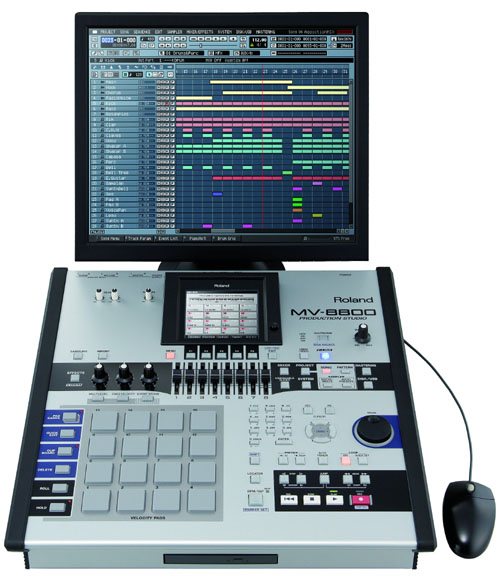
Roland MV8800
The recorder you choose be it a multi track, computer sequencer, or MPC 4000 and MV8800 are the most far reaching decision you can make. But, you have to consider that choice carefully. It is advisable to learn one form and master it, and then you can resort considering buying them.

There are stores that offer 30 days return policy on music gear. This can also be a great idea that makes it real easy for you. Get it for trial and when you find it is perfect for you then only you can opt to buy. 

Many people face a lot of difficulties with the software they buy because they do not understand or misread the recommended requirements to run the software. Never buy software if you cannot meet the stated requirements.

When buying a music gear try to stick to the companies that are supremely focused on your computer platform, your operating system and in some cases your motherboard and your CPU. Some soundcard drivers may refuse to work well with some chipsets on some motherboards.

Do a thorough research before buying music gear. Ask questions from your dealer or you will end up spending extra for your digital mixer. Therefore, the price of a piece of gear, which is at a lower price, may mean spending another extra dollars to make it work. 

Always buy the latest music gear to avoid future expenditure. Buy the cheaper or a secondary music gear now, and then it will be outdated in some years and you will have to buy the new one and this will cause unnecessary expenditure. It is best to wait a year or two after the release and then buy the finished, mature, stable products. Features may look good on paper but may not sound good in music. If you buy cheap music gear you may just end up buying again. 

Besides the above mentioned tips of buying music gear, there are other variables you need to look into, like the cost of service, the upgrades, software and many more. Above all, the bottom line is the sound that should be your prime concern. Focus on the sound coming out of the speakers. Great sound never goes out of style.

About the Author:
Victor Epand is an expert consultant for music gear, speakers, and microphones. You can find the best marketplace for music gear, speakers, and microphones at these 3 sites: music gear, music equipment, studio music gear, Sonar, speakers, and laser microphones, parabolic microphone.
Article Source:
Include this link when reprinting this article: http://www.freearticles.co.za/music/tips-buying-music-gear-home-studios.html

Basic Gear for Recording Music

by Victor Epand

There are various gear for recording music. One type of gear operates and affects the ultimate music quality in one way, and the other in a completely different way. To create and compose excellent music with high quality receptive sound, you need to know the details of these various types of gear.

Multitrack recorders can be analog cassette tapes. It can record multiple tracks at a very limited amount of space and number of possible tracks. These are usually the cheapest multitrack recorders. Another is the Digital tape. These are removable digital tapes similar to Zip and Jazz Drives. Then there is the Hard Disk. The multitracker is a form of a hard drive of a computer, which will enable you to store much more work than a tape. Some hard drives can also be upgraded at memory and they are removable.

Another is the Removable Disk. They are removable analog disks that can store more information than cassettes. The disk is usually specific to the manufacturer. The other is the CD, which includes TASCAM CC 22MKIII, a Pro CD recorder with MP3 playback and ROLAND CD 2, an audio recorder that can record sound onto Compact Flash and CD burner. 

Microphone is the most important gear for recoding music. The utility value of your microphone depends on two factors, one is the quality and the other is the consistency. Consistency is important, as psychological factors are so great in the perception of sound and because eventual usages of your sound resources may result in arbitrary segments played in juxtaposition. 

Studio monitor, also known as the reference monitor, is one of the gear for recording music. There are loudspeakers specially designed for music production of the source material. They generally attempt to paint an accurate audio image of the material with no unnatural emphasis or de emphasis of a particular frequency.

Mixer is another gear for recording music. This is an audio device with one or more lines. It may be an electronic or mechanical instrument. An electronic mixer device mixes signals. It also offers frequency mixers, a telecommunications device used to alter the carrier frequency of a signal. It supports audio mixing console, an electronic device for combining, routing and changing the level of tone or dynamics of two or more audio signals. It can also combine 15 or more video signals. It offers mode mixer, a telecommunications device for handling signals on optical fibers.

Audio interface with in and out configuration, complete with preamps, is one of the perfect gear for music recording. It offers routing of discrete output to a mixer or directly driving it to a surround sound system. 

Studio Signal Processor is another gear for music recording. An audio signal processing is the processing of a representation of auditory signals or sound. The representation can be digital or analog. An analog representation is usually electrical and the voltage level represents the air pressure waveform of the sound. Whereas a digital signal representation expresses the pressure waveform as a sequence of symbols, usually binary numbers, which permit digital signal processing. The processing methods and application areas include storage, level compression, data compression, transmission, enhancement for example equalization, filtering, noise cancellation, echo or reverb removal or addition and many more.

The above mentioned gears for recording music are some of the basic necessities that makes a complete recording unit and added to that there are few other accessories such as bag and cases, cables, headphones, and many more.

About the Author:
Victor Epand is an expert consultant for music gear, speakers, and microphones. You can find the best marketplace for music gear, speakers, and microphones at these 3 sites: music gear, music equipment, multitrack recorder, Mixer, speakers, and laser microphones, parabolic microphone.
Article Source:
Include this link when reprinting this article: http://www.freearticles.co.za/music/basic-gear-recording-music.html

Related Posts with Thumbnails