English French German Spain Italian Dutch Russian Portuguese Japanese Korean Arabic Chinese Simplified

this widget by www.AllBlogTools.com
Showing posts with label Gear. Show all posts

Different Types of Guitar Amps

by Rocky vj

Once you have selected your guitar, you require finding an amp to go with it. Today there are various options available depending on size, sound, amplifier technology and configuration. We are here to give you some useful and necessary information that would steer you through the maze.

Various types of Amplifiers

There are basically four types of guitar amplifiers: Solid-state (analog), Tube, Modeling (digital), and Hybrids.

Solid-state Amps - These guitar amps are recognized solid-state as they use transistors for their preamp and for power sections as an alternative of tubes. They are extremely trustworthy and hardly ever require repairs. They normally have a very fresh tone, even though many come with "distortion" channels also. These amps are all the rage with players looking for a strong, dependable touring amp.

Tube Amps - Tube amps are favored by many guitarists for their tepid, fat tone and as well for the "organic" distortion. Tube amps are generally sound louder than solid-state amps of the same wattage and have an exact "feel", which you do not acquire from solid-state amps. Most tube amps have different channels, which could be switched from clean to distorted tones instantly. Tube performance could also be deteriorating over time, so tubes require changing occasionally.

Modeling Amps (Digital Amps) - Modeling amp uses digital processors to reproduce the sound of traditional and contemporary tube technology. Using software that "models" the sound of tube amplifiers (and cabinets); these amps put the sound of various amps in one box. Modeling amps are programmable, and frequently have fitted digital effects like delay, chorus, etc. Some as well comprise of digital or even for analog outputs with orator simulation for going direct in to a recording border or P A system.

Hybrid Amps - Combining the best of each kind of guitar amp into one package, these amps use a real tube in combination with the solid state power part of their amps. Marshall Valve state amps use tubes in the preamp part and solid state circuitry in the power section to make a tube tone with no necessity the use of power tubes.

Rocky is a Copywriter of www.gigasonic.com

He has written many articles in various topics.For more information visit:For more information visit:
www.gigasonic.com/alesis-hd24-recorder.html
source : http://www.valuablecontent.com/articles/27255/1/Different-types-of-Guitar-Amps

Tips on Buying Music Gear for Home Studios

by Victor Epand

Owning your recording studio at your home is an added advantage when you are a composer. But it is a challenge for getting the right kind of unit to sustain for a longer period of time and save money in the long run. Getting yourself an outdated system can not be worthwhile and reasonable. You cannot work for long with such system. This can cause you to spend more again and again. You should know what you want and get the compatible devices. Here you can find some of the basic tips on buying music gear that can guide you to assure the best results and save you from unnecessary expenditure. 

First of all you need to decide what kind of studio you want. There is a pro studio ideal for recording full bands. This kind of studio can deliver CD master recordings. The other is a project studio, which generally supports recording electronic synths, samplers and maybe a few live players when needed. The quality level meets TV and film standards. 

Another form of studio is the home MIDI electronica mainly software studio with at least one or two mics. It could also be a demo or a song writing studio with mics or even just a little hobby studio, or just want to make music studio. All the above mentioned options can be accomplished but there are certain things you also need to look into really carefully before buying music gear. 

Avoid buying the same feature over and over again on different pieces of music gear. You may only end up otherwise having a number of preamps, samplers and recorders that you cannot use and they are just an additional expenditure. 

Do not buy Cubase and Sonar and try to get them to work together. Or get Sound Forge and Sonar, as these applications will not work at all on a Mac. Therefore, it is advisable to be well versed with the music gear before purchasing them. 

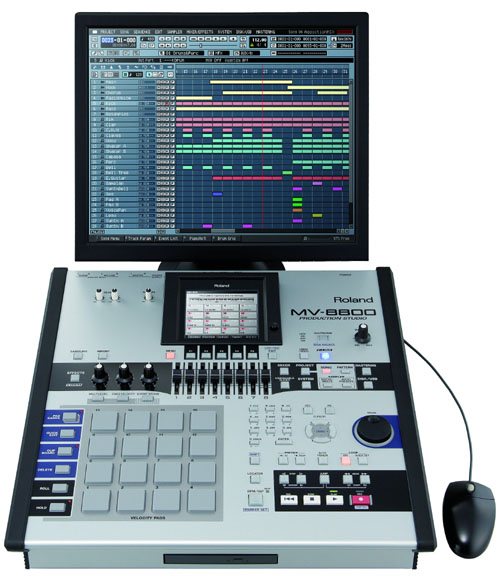
Roland MV8800
The recorder you choose be it a multi track, computer sequencer, or MPC 4000 and MV8800 are the most far reaching decision you can make. But, you have to consider that choice carefully. It is advisable to learn one form and master it, and then you can resort considering buying them.

There are stores that offer 30 days return policy on music gear. This can also be a great idea that makes it real easy for you. Get it for trial and when you find it is perfect for you then only you can opt to buy. 

Many people face a lot of difficulties with the software they buy because they do not understand or misread the recommended requirements to run the software. Never buy software if you cannot meet the stated requirements.

When buying a music gear try to stick to the companies that are supremely focused on your computer platform, your operating system and in some cases your motherboard and your CPU. Some soundcard drivers may refuse to work well with some chipsets on some motherboards.

Do a thorough research before buying music gear. Ask questions from your dealer or you will end up spending extra for your digital mixer. Therefore, the price of a piece of gear, which is at a lower price, may mean spending another extra dollars to make it work. 

Always buy the latest music gear to avoid future expenditure. Buy the cheaper or a secondary music gear now, and then it will be outdated in some years and you will have to buy the new one and this will cause unnecessary expenditure. It is best to wait a year or two after the release and then buy the finished, mature, stable products. Features may look good on paper but may not sound good in music. If you buy cheap music gear you may just end up buying again. 

Besides the above mentioned tips of buying music gear, there are other variables you need to look into, like the cost of service, the upgrades, software and many more. Above all, the bottom line is the sound that should be your prime concern. Focus on the sound coming out of the speakers. Great sound never goes out of style.

About the Author:
Victor Epand is an expert consultant for music gear, speakers, and microphones. You can find the best marketplace for music gear, speakers, and microphones at these 3 sites: music gear, music equipment, studio music gear, Sonar, speakers, and laser microphones, parabolic microphone.
Article Source:
Include this link when reprinting this article: http://www.freearticles.co.za/music/tips-buying-music-gear-home-studios.html

Basic Gear for Recording Music

by Victor Epand

There are various gear for recording music. One type of gear operates and affects the ultimate music quality in one way, and the other in a completely different way. To create and compose excellent music with high quality receptive sound, you need to know the details of these various types of gear.

Multitrack recorders can be analog cassette tapes. It can record multiple tracks at a very limited amount of space and number of possible tracks. These are usually the cheapest multitrack recorders. Another is the Digital tape. These are removable digital tapes similar to Zip and Jazz Drives. Then there is the Hard Disk. The multitracker is a form of a hard drive of a computer, which will enable you to store much more work than a tape. Some hard drives can also be upgraded at memory and they are removable.

Another is the Removable Disk. They are removable analog disks that can store more information than cassettes. The disk is usually specific to the manufacturer. The other is the CD, which includes TASCAM CC 22MKIII, a Pro CD recorder with MP3 playback and ROLAND CD 2, an audio recorder that can record sound onto Compact Flash and CD burner. 

Microphone is the most important gear for recoding music. The utility value of your microphone depends on two factors, one is the quality and the other is the consistency. Consistency is important, as psychological factors are so great in the perception of sound and because eventual usages of your sound resources may result in arbitrary segments played in juxtaposition. 

Studio monitor, also known as the reference monitor, is one of the gear for recording music. There are loudspeakers specially designed for music production of the source material. They generally attempt to paint an accurate audio image of the material with no unnatural emphasis or de emphasis of a particular frequency.

Mixer is another gear for recording music. This is an audio device with one or more lines. It may be an electronic or mechanical instrument. An electronic mixer device mixes signals. It also offers frequency mixers, a telecommunications device used to alter the carrier frequency of a signal. It supports audio mixing console, an electronic device for combining, routing and changing the level of tone or dynamics of two or more audio signals. It can also combine 15 or more video signals. It offers mode mixer, a telecommunications device for handling signals on optical fibers.

Audio interface with in and out configuration, complete with preamps, is one of the perfect gear for music recording. It offers routing of discrete output to a mixer or directly driving it to a surround sound system. 

Studio Signal Processor is another gear for music recording. An audio signal processing is the processing of a representation of auditory signals or sound. The representation can be digital or analog. An analog representation is usually electrical and the voltage level represents the air pressure waveform of the sound. Whereas a digital signal representation expresses the pressure waveform as a sequence of symbols, usually binary numbers, which permit digital signal processing. The processing methods and application areas include storage, level compression, data compression, transmission, enhancement for example equalization, filtering, noise cancellation, echo or reverb removal or addition and many more.

The above mentioned gears for recording music are some of the basic necessities that makes a complete recording unit and added to that there are few other accessories such as bag and cases, cables, headphones, and many more.

About the Author:
Victor Epand is an expert consultant for music gear, speakers, and microphones. You can find the best marketplace for music gear, speakers, and microphones at these 3 sites: music gear, music equipment, multitrack recorder, Mixer, speakers, and laser microphones, parabolic microphone.
Article Source:
Include this link when reprinting this article: http://www.freearticles.co.za/music/basic-gear-recording-music.html

Related Posts with Thumbnails