English French German Spain Italian Dutch Russian Portuguese Japanese Korean Arabic Chinese Simplified

this widget by www.AllBlogTools.com
Showing posts with label music theory. Show all posts

Chord Progression : The Basics

A chord progression (or harmonic progression) is a series of musical chords, or chord changes that "aims for a definite goal" of establishing (or contradicting) a tonality founded on a key, root or tonic chord. Chords and chord theory are generally known as harmony.

A chord progression can be thought of as a harmonic simultaneity succession: it offers an ongoing shift of levelOceania and South/West Africa. A change of chord, or "chord change", generally occurs on an accented beat, so that chord progressions may contribute significantly to the rhythm, meter and musical form of a piece, delineating bars, phrases and sections. that is essential to the music of Europe (at least since 1600),

A chord may be built upon any note of a musical scale, therefore a seven-note scale allows seven basic chords, each degree of the scale becoming the "root" or "tonic" of its own chord. A chord built upon the note A is an A chord: however, since any progression may be played in any key, the fundamentals of harmony are best grasped by numbering the chords according to the step of the scale they are built upon, upwards from the key-note. The structural meaning of a harmony depends exclusively upon the degree of the scale.

Any major scale gives three major triads that together include, and so can harmonize, every note of that scale. They are based on the first, fourth, and fifth scale degrees (the tonic, subdominant and dominant).

Diminished Chords
The same scale also provides three relative minor chords, one related to each of the three major chords. These are based upon the sixth, second and third degrees of the major scale and stand in the same relationship to one another as do the three majors, so that they may be viewed as the first, fourth and fifth degrees of the relative minor key. Apart from these six common chords there will be one step of the scale that gives a diminished chord.

In addition, extra notes may be added to any chord. If these notes are also selected from the original scale the harmony remains diatonic. If new chromatic intervals are introduced then a change of scale or modulation occurs, which may bring the sense of a change of tonal center. This in turn may lead to a resolution back to the original key, so that the entire sequence of chords helps create an extended musical form.  

Although all this allows for a large number of possible progressions (depending upon the length of the progression), in practice progressions are often limited to a few bars' length and certain progressions are favored above others: there is a certain amount of fashion in this and a chord progression may even define an entire genre.

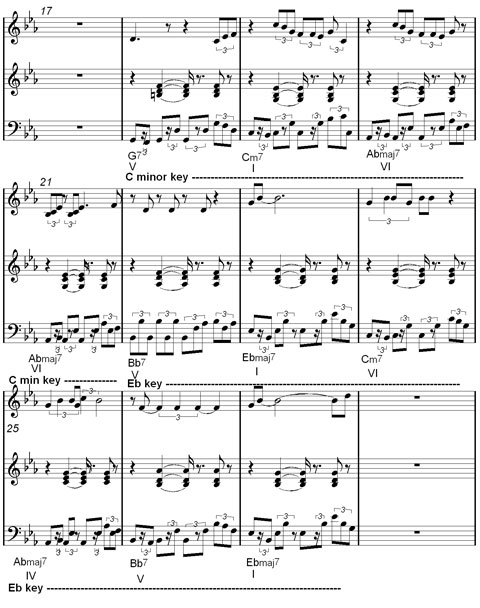
In western classical notation chords built on the scale are numbered with Roman numerals. A D chord will be figured I in the key of D, for example, but IV in the key of A. Minor chords are signified by lower case Roman, so that D minor in the key of C would be written ii. Other forms of chord notation have been devised, from figured bass to the chord chart. These usually allow or even require a certain amount of improvisation. [source : Basic Chord Progression]

Beginner Piano Lessons


There is no doubt about it that the new year is the greatest time to start going through with beginners piano lessons. If you have been thinking of enrolling your child in piano lessons, do not wait since piano learning lessons have valuable educational advantages for young kids. Parents know this, but the most common excuse given is "we don't have room in our home for a piano." This is an old fashioned excuse, because modern pianos come in all sizes. Just review the list of options outlined below and decide right now.

1. 76 key Portable Keyboard with Stand with Bench - Not a full size piano, but your beginner can practice on this for several years. It's light weight, you can set it up anywhere, store it in the coat closet if you have to, and easily take it to grandma's house. Get one with touch-sensitivity. I recommend you acquire a Yamaha for the reason that they have a very beautiful tone. Invest in a $20 portable bench also, because posture is especially important for beginners.

2. Full-size Portable Keyboard with Stand with Bench - This is an 88 key, full piano keyboard, but without the case. You just set it up on a stand anywhere, anytime. It is heavier, but still extremely portable and takes up a small amount of space. The Yamaha's and Casio PX100 are great for beginners.

3. Acoustical Piano's Now Come in All Sizes - You shouldn't be afraid to look into this possibility. You can find a size that is not much bigger than a full-size keyboard. It won't be portable, but it also won't be the two-ton, back-breaking monster to move that your great grandmother had either. And it won't take up nearly the space. Acoustical piano instruments could also be rented to supply you with an opportunity to attempt to use it within your household first.

4. A Beautiful Grand Piano Can't be Matched for Playing Enjoyment and Artistry - If you are searching for a family heirloom your kids could pass along to your grand children make this investment. Grand pianos hold their value if you care for them and can even increase in value. Grand pianos also come in different sizes from 5 feet to 9 feet, as well as any wood tone, lacquered finish, and style to match your home d�cor.
 
Commence your new year by buying a piano that is appropriate for your household, and you and your children will enjoy the benefits for years to come. 

Click Here If you wish to understand much more about playing the piano and progress from a beginner to an experienced piano player fast then you certainly require these expert Beginners Piano Lessons that can certainly assist you.
Article Directory : http://ArticleDirectory.com

Spruce Up Your Guitar Playing through Guitar Arpeggio Exercises


Guitar arpeggio exercises are an additional tool to include into your practice time. These will help spruce up your right and left hand methods since it's mostly picking.

Arpeggio means that you are trying to play a shattered chord. This means that you're playing notes one at a time rather than playing all the strings like you do when strumming. You are still chording with the left hand but simply picking or using finger style along with the right.

The easiest exercise if you are a newcomer is to place your fingers on the fretboard to make a chord and simply pick each string all the way up from E to E then back down. You can play whole tunes in this way by choosing each chord similar to this while you switch up chords. Sometimes you'll have to work on your timing a little bit, however, you will figure it out soon especially if you know the song by heart.

Another exercise is to complete the same thing but omit strings. This can build your right hand's awareness knowing where each string is. Oftentimes at first you may miss a lot but this would enhance that accuracy and reliability.

Try out creating your own patterns too. There aren't any guidelines to what workouts that you need to do. Just make up something and stick to it. But what ever you decide to do, act as disciplined enough to stick to it so as to practice a sequence.

One tip is to play these exercises with some type of beat in the background to ensure you remain on rhythm. You possibly can increase the rhythm as the exercise becomes simpler that may help you learn how to go quite a bit faster. Be cautious that you just don't give up quality for pace. Whenever actively playing arpeggio, your goal is for each note to be crisp and clear. 

Want to find out more about Best Infant Car Seats, then visit the author's site at infantcarseatshop.org to find about Britax Infant Car Seat.
Article Source: http://ArticleDirectory.com

Music Theory & Harmony: The Key To Understanding How Music Works!

 
It's a sad fact that most people, including piano players, regard music theory and harmony as some abstract concept that has very little to do with the songs they play on their pianos. Nothing could be further from the truth. Knowing music theory and harmony is the key to opening a whole new world of exciting insights into the songs we play, and enable us to do things on the piano we never dreamed we could do, to say nothing of enjoying the process a hundred times more.

What is music theory, and how can I benefit?

Here are just a few of the wonderful skills and insights a person benefits from by learning music theory:
How notation works -- a huge advantage in sight-reading.

The hierarchy of rhythm -- solving rhythm problems before they begin.

All kinds of scales -- the "ladders of notes" every song is composed of. Major scales, 3 types of minor scales, chromatic scales, whole tone scales, modal scales.

How transposition and modulation works -- playing songs in different keys, and getting from one key to another smoothly.

Complex time signatures, and what they tell you.

Perfect, major & minor intervals -- helps ear training greatly.

Two-part and four-part harmony.

Figured bass such as IV, V7, ii6, I6/4, etc. and how it relates to chord symbols such as Fm7, F6, Dmaj7, etc.

Harmonizing melodies with all these chords.

Open & close voicing, inversions, secondary chords, form, cadences, non-harmonic tones, arranging for voices, arranging for brass, arranging for strings, transposing instruments, key relationships and many other exciting insights into the inner workings of music!

But what is harmony?

Harmony is a sub-set of music theory. It is a series of notes in combination, played simultaneously. Listen to your favorite songs, and pay close attention to the back-up vocals when they're being sung along with the lead. Can you hear how the two vocal melodies differ in pitch? That's harmony, and it's highly possible that those back-up vocalists were chosen because of their strong ability to harmonize.

Singing a harmony, or rather picking one out on your own without written sheet music, is an almost inherent musical skill that many singers would die to possess. But harmony isn't just the province of singers; it's found in every single area of music. Any time a sound is layered on top of another sound and those sounds match each other in rhythm and melody (but not pitch), a harmony is created.

Harmony is made of intervals, and as such, it can be considered dissonant (scratchy, uncomfortable, like playing an E and an F at the same time) or consonant (pleasing or smooth). What makes a harmony pleasing or unpleasing, however, is extremely relative. In medieval times, only octaves and perfect fifths were considered harmonious, and any harmony that deviated from that was generally frowned upon. In modern western music, though, nearly everything is considered to be harmonious by someone. Fifths are still very popular in modern harmony but are now used in the most unlikely of places; heavy metal music, for example, frequently uses perfect fifths in the vocal harmony to create an eerie effect when layered on top of the more dissonant instrumentation.

Harmony, in addition to being consonant or dissonant, can also be subordinate or coordinate. Subordinate harmony, the tonal harmony used most frequently today, is a series of harmonies that are based on each other. The harmony moves in such a way that a resolution is somewhat predictable; you can hear this type of harmony in modern pop music, musical parts that flow very easily into each other and don't leave the listener baffled as to the turn the song has taken. On the other hand, coordinate harmony is a series of harmonies that operate independently of each other. They do have some common relation, of course, but don't typically move toward a goal, or predictable resolution. Renaissance musicians often used this type of harmony, and it's capable of producing rich and moving textures within a piece of music.

Learning music theory and harmony is not just an option you can take or leave: it is part and parcel of the "stuff of music". No surgeon would ever say "I don't want to learn all that stuff about the nervous system & the skeletal system and blood vessels and how the lungs and heart works and all that stuff -- I just want to operate".

And yet the majority of piano players ignore the very thing that would take them to the next level in their playing and knowledge -- music theory & harmony.

Source: http://www.articlecircle.com/ - Free Articles Directory

About the Author

For more information on music theory & harmony, please go to http://www.playpiano.com/Articles/32-musictheoryharmony.htm
Related Posts with Thumbnails